
Popular bitcoin advocates and the traditional financial industry are both failing retiring bitcoiners. HODL is not a sound retirement plan and you may be better off lighting your money on fire than holding a standard 60/40 in today’s environment.
The retirement portfolios that will win over the next decade will provide downside protection and diversification, without sacrificing growth. They will be positioned to benefit from volatility, the fourth turning, and monetary debasement without taking you on an involuntary roller coaster ride.
The good news? You don’t have to choose between being all in on bitcoin or reluctantly holding too much in failing government bonds.
You can have your peace in retirement without giving up on your bitcoin thesis.
We’re living through the final stage of US dollar dominance and the fiat currency experiment. Financial repression and monetary debasement are necessary evils to keep this financial system alive and they are the biggest risks to your portfolio. Real returns matter now more than ever. You can’t afford to lose ground to inflation when it will be most rampant and you will be most vulnerable. The Fourth Turning is playing out in real time and portfolios that worked from 1980-2020, will not work for 2020-2040. Your strategy must adapt to this new regime.
We believe a systematic, trend and momentum strategy is built exactly for this environment. An environment that will be erratic and unpredictable, but with strong directional moves. A systematic strategy doesn’t need to predict the future to work, it simply needs to react to the market to position clients where their money can ride the waves of what’s working and shift when a new trend emerges. And this isn’t just our opinion or rooted in hope, it’s backed by a century of data.
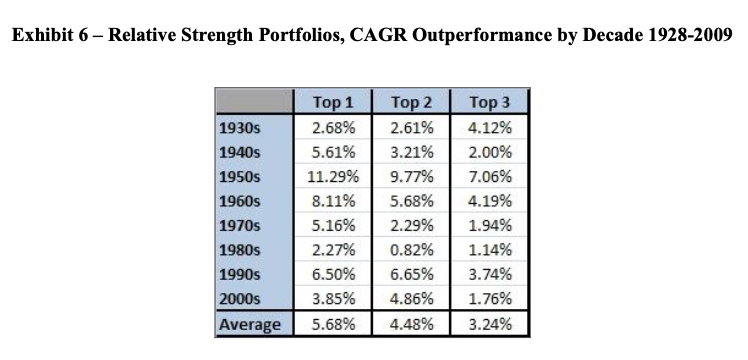
This chart clearly demonstrates a momentum approach works better than buy and hold investing across decades. What you’re seeing is the relative outperformance of this simple approach I’ll describe next above the S&P 500 during the various timeframes on the left. The approach is to split the S&P 500 into every individual sector it tracks like financials, technology, consumer goods, etc. and each month review what the performance of each sector has been over the last 12 months. The first column assumes you held the top 1 performing sector only, second column top 2, and third column top 3. Then each month you re-run those numbers and hold the top 1, 2, or 3 performing sectors that next month. If the top performers are the same as the previous month, you don’t change your holdings.
As you can see, this simple approach consistently outperformed buying and holding the S&P 500 index in every decade with an average relative outperformance of 5.68% for holding the top 1 sector each month, 4.48% for holding the top 2 sectors each month, and 3.24% for holding the top 3 sectors each month. Not only does it consistently outperform, but it’s also worth noting that concentration is rewarded within these strategies. The performance advantage diminishes the more sectors you hold. We have incorporated this lesson into our approach.
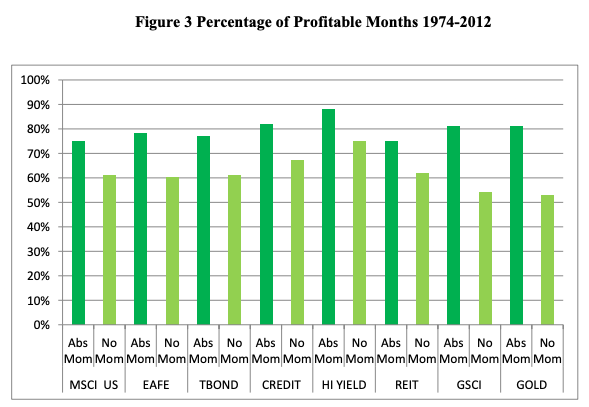
Within Fluvius, we incorporate two types of momentum approaches, relative strength discussed previously and absolute momentum which I will explain now. The chart above shows the percentage of profitable months utilizing a simple absolute momentum strategy versus a buy and hold strategy.
The absolute momentum approach is comparing an asset class’ prior 12 months performance to the performance of short term treasury bills each month. Whichever asset class has performed better over the prior 12 months is the asset class you hold for the following month. Re-run the numbers at the start of each month to determine your holding for the following month.
The first 2 vertical bars are looking at US stocks from 1974-2012 with this simple analysis performed monthly to determine whether or not an investor should hold US stocks or treasuries for the following month. As you can see, utilizing this absolute momentum approach led to more profitable months than buying and holding the asset class.
Not only did this prove to be true for US stocks, it was true for every other asset class listed as well – international stocks (EAFE), treasury bonds, credit, high yield bonds, reit’s, commodities, and gold. An investor following this strategy over this time frame would have experienced more profitable months in each asset class. What’s even more surprising is that, not only did it lead to more profitable months, it also led to less severe monthly drawdowns as well (see below).
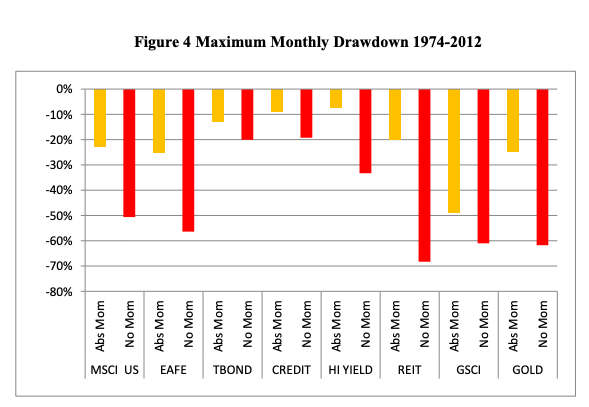
Utilizing that same absolute momentum approach described above, an investor experienced less severe monthly drawdowns across all listed asset classes as well. To me that’s remarkable, but at the least it is interesting.
There is a much deeper base of research backing the efficacy of trend and momentum strategies that I won’t expand on in this article, but feel free to do your own research. The point is, trend and momentum strategies can work and work well over long periods of time, across multiple asset classes, and in various market regimes.
First, and most importantly, we incorporate bitcoin as a standalone asset class within Fluvius. That on its own differentiates us and Fluvius from 98% of the wealth management industry (maybe more).
Second, we developed an independent sleeve structure to incorporate multiple asset classes within one portfolio; equities, commodities, and bitcoin.
Third, we developed proprietary risk management measures unique to each asset class, because each asset class behaves differently. Compare that to the above research from Antonacci, he used the same trading logic across all asset classes in his research and it worked. But we found it works better to tweak the logic to the asset class based on its historical trading behavior.
Finally, we designed it with the fiat system and investor psychology in mind. We minimize the amount of time we hold cash. Most people give up on momentum strategies at precisely the wrong time due to broad market underperformance. We discovered that just because we may not be invested in one asset class, another might still have a positive trend with momentum, so why not hold the other asset class instead of holding cash as most long only momentum strategies default to.
Systematically invests in assets with strong momentum behind a positive trend, so our clients aren’t passively at the mercy of the markets.
Automatically adapts to the current market environment, so your portfolio is positioned for what’s happening.
Protects client assets, so that your money can “get out” during prolonged market crashes or extreme volatility.
Benefits from the growth of Bitcoin, but protects clients from the severe drawdowns. Fluvius is not dependent on Bitcoin for performance, so it provides our clients diversified returns that help them weather Bitcoin bear markets through retirement.
Fluvius only utilizes ETF securities, no individual stocks. This contributes to the diversification and risk management of the strategy. It is designed to capture long term trends in various areas of the markets, not catch the next hot stock and take unnecessary risk attempting to do so.
Analysis and trades are performed on the first of every month. We do have a mid-month risk management review that could lead us to decrease or increase position size on an asset already held, but we do not switch holdings intra-month, only on the first trading day of each month.
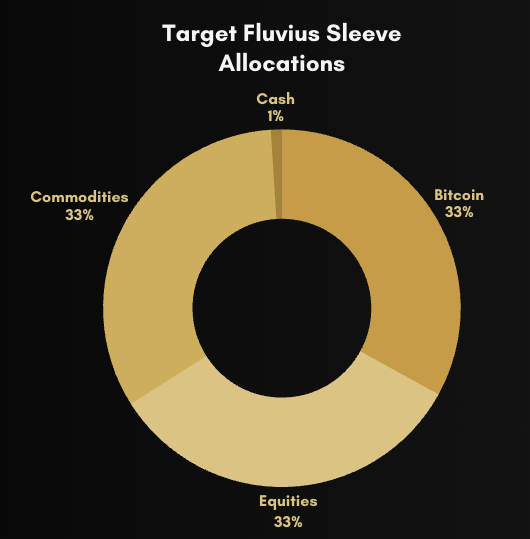
Below are the Fluvius sleeves and their associated target allocations. I say target, because the allocations can and do fluctuate over time as asset prices fluctuate and we receive buy or sell signals. The allocations listed below are representative of the target allocations when all 3 asset classes receive full buy signals and trigger no risk management thresholds. We hold a 1% cash allocation within all portfolios as a liquidity buffer and a reserve to pay our fees directly out of client accounts. This model is for illustrative purposes only and does not constitute investment advice or a recommendation to buy or sell specific securities. If you would like a suitable recommendation for your circumstances, schedule a complimentary discovery call through the link above.
Now, when we say we perform analysis every month, these are the 3 primary questions that Fluvius answers monthly and in general as a portfolio strategy. Those 3 questions are as follows:
#1 - What asset classes should we hold?
Bitcoin, Commodities, or Equities.
#2 - Which investments (ETFs) within those asset classes should we hold?
We have a preselected pool of ETFs the strategy chooses from that are decided by us and rarely change.
#3 - How much of each investment should we hold (allocation %)?
This can vary between 100%, 75%, or 25% of target allocation.
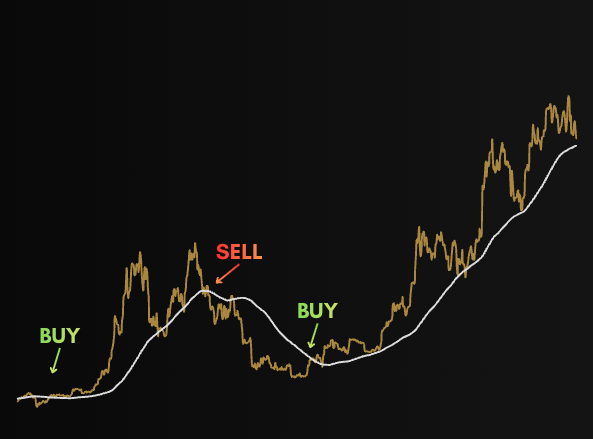
This graphic is for illustrative purposes only and does not represent actual trades executed by Strong Wealth.
The graphic above represents our simple bitcoin trading logic.
Question #1: Should we hold bitcoin?
Answer: If bitcoin’s actual price is above the trend line, that’s a buy signal. If bitcoin’s actual price is below the trend line, that’s our sell/allocate elsewhere signal.
Question #2: What investments should we hold within bitcoin?
Answer: There’s only one option, bitcoin via Fidelity’s ETF $FBTC.
Question #3: How much of each ETF should we hold?
Answer: It’s all or nothing for bitcoin. 100% or 0% of target.
Often folks are surprised by the simplicity and ask if we tried other methods. Yes, we tested many different methods and it became clear that the more complex the signal, the worse it performs. This method is designed to capture the long term trends of bitcoin, not every short term reaction.
The commodity and equity sleeves are slightly more complex, but ultimately easy to understand.
Question #1: Should we hold commodities?
Answer: Has Gold outperformed short term treasuries over our lookback period? If yes, hold commodities. If not, sell/allocate elsewhere. We do not publicly share our look back period, if you’d like to learn more, schedule a call with us.
Question #2: Which investments should we hold within commodities?
Answer: Which ETFs have performed the best over our lookback period? We hold the top 2 performing ETFs for the following month.
Question #3: How much of each ETF should we hold?
Answer: Is the ETF’s recent volatility normal, elevated, or extreme compared to its historical volatility?
If it’s normal, we hold 100% of target allocation. If it’s elevated, we trim to 75% of target allocation. If it’s extreme, we limit our exposure to 25% of target allocation.
Question #1: Should we hold equities?
Answer: Are any ETFs from our pre-selected pool above their trend line? If yes, hold equities. If not, allocate elsewhere.
Question #2: Which investments should hold within equities?
Answer: Over our lookback period, which ETF has performed the best? We will hold the top performer for the next given month.
Question #3: How much of each ETF should we hold?
Answer: Is the ETF’s recent volatility normal, elevated, or extreme compared to its historical volatility?
If it’s normal, we hold 100% of target allocation. If it’s elevated, we trim to 75% of target allocation. If it’s extreme, we limit our exposure to 25% of the target allocation.
Simple enough? I’d say so. Now, I know this may not connect all the dots for you, so don’t hesitate to schedule a complimentary discovery call to learn more.
Unfortunately, registered investment advisor regulation prevents us from publicly sharing the strategy performance data. Schedule a call with us through the link above to learn more about the historical performance of this strategy.
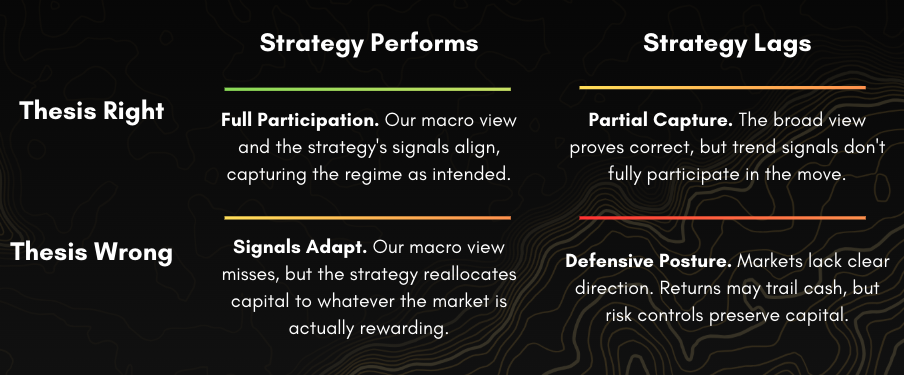
The primary takeaway from this matrix is that failure of the strategy and our thesis of the financial world would likely result in underperformance. However, because of the nature of momentum strategies and our risk management measures, that failure scenario is not a catastrophic failure scenario. Three of the four possibilities result in positive outcomes. And the fourth is a negative outcome, but not catastrophically negative.
Trend and momentum strategies can underperform buy and hold strategies when there is not a definitive trend in the market. Choppy markets can lead to false positive buy and sell signals causing overtrading with no performance or risk management benefit.
For example, let’s say bitcoin and commodities are flat for an entire decade, but chop around our buy/sell signals during that time. This is a scenario where Fluvius could substantially underperform a traditional stock/bond portfolio, because we would be allocated to bitcoin and commodities while they are going nowhere and only 33% of the portfolio would be allocated to equities. So in theory, a 100% equity – buy and hold portfolio would significantly outperform Fluvius over a long period of time.
If bitcoin were to experience an overnight or swift security failure of some kind while we are allocated, we could lose our entire principal before the Fluvius trade signals would kick in due to the (intentional) time delay of strictly monthly trades. Theoretically, there could be a 30 day window of catastrophe where we remain allocated. In this scenario, there is a possibility of emergency intervention, but if the worst case scenario is unfolding it’s unlikely we’d be able to sell easily due to very little buy side liquidity in the market. There is the risk of regulatory action against bitcoin like there was with gold back in the 1930s. That could substantially hurt the performance of bitcoin and therefore Fluvius.
Absolutely not, our clients typically retain a cold storage allocation to bitcoin that is completely separate from Fluvius. Learn more about our two bucket approach by reading this article.
If assets are held within retirement accounts, there are no tax consequences for active trading. However, within a taxable brokerage account, we have estimated the tax drag to be 3-6% on the compound annual growth rate. That number alone means nothing, so schedule a complimentary discovery call to learn more about the actual performance of Fluvius.
Yes, we can easily facilitate transfers from any custodian. Our custodian (Altruist) can support every standard account type. There are no tax implications associated with moving retirement accounts from one custodian to another as long as the account types are equivalent.
Yes, $500,000 per household to get started. It can be a mix of multiple accounts.
No, we intentionally built the strategy to balance all three asset classes symbiotically. There’s strong data backing the design choices we made.
It depends on account size, but our minimum fee is 1% of assets under management annually.
This blog post is provided by Strong Wealth for educational and informational purposes only. It is not investment, tax, legal, or accounting advice, and it is not an offer, solicitation, or recommendation to buy or sell any security, digital asset, or investment strategy. The Fluvius strategy is described here for illustrative purposes; whether it is appropriate for any particular investor depends on that investor's individual circumstances, goals, risk tolerance, and tax position. The target allocations, sleeve structures, trading logic, and success/failure scenarios shown are illustrative and do not represent actual client portfolios or executed trades.
Investing involves risk, including the possible loss of principal. No investment strategy — including Fluvius — can guarantee a profit, protect against loss, or eliminate downside risk. References to features such as "downside protection," "adaptability," or "risk management" describe design intent and are not assurances of outcome. Systematic, trend-following, and momentum-based strategies are subject to model risk and may materially underperform traditional buy-and-hold or balanced portfolios during certain market environments, including but not limited to choppy or trendless markets, sudden reversals, and prolonged periods where signals produce false positives. Monthly trading cadence introduces an intentional time lag during which adverse market events may occur before the strategy can respond.
Bitcoin and other digital assets carry unique and elevated risks, including extreme price volatility, regulatory uncertainty, custody and cybersecurity risk, liquidity risk, and the potential for total loss. Commodities and equities carry their own asset-class-specific risks.
The third-party research referenced in this post (including work by Meb Faber and Gary Antonacci) is cited for educational context only. Strong Wealth has no affiliation with these researchers, and their inclusion does not constitute an endorsement of Strong Wealth by them, or of their work by Strong Wealth as a prediction of future results. Past performance and historical or backtested research results are not indicative of future results. Backtested and academic research reflects the application of a strategy or methodology with the benefit of hindsight; actual results achieved by any investor will differ and may differ materially.
Strong Wealth does not publicly disclose Fluvius performance data in this post. Any performance information provided to prospective clients in a private setting will be presented in accordance with applicable regulatory requirements, including SEC Rule 206(4)-1.
The tax estimate referenced ("3–6% tax drag on compound annual growth rate") is a general internal estimate based on assumptions that may not apply to your situation; it is not tax advice. Consult a qualified tax professional regarding your circumstances.
Fees, account minimums, conflicts of interest, and the full scope of Strong Wealth's advisory services are described in Form ADV Part 2A and Form CRS, available upon request and at adviserinfo.sec.gov. Strong Wealth is an investment adviser registered with the state of its principal place of business. References to a "complimentary discovery call" are an invitation to discuss whether an advisory relationship may be appropriate; such calls do not themselves constitute investment advice and do not create an advisory relationship.